
USA Rolex Super Clone: Fake Watches, Modern Edge
USA Rolex Super Clone: Fake Watches, Modern Edge
A Practical Buyer’s Guide to the 4131 Daytona Super Clone in the USA
Why the 4131 Movement Is the Only Version Worth Considering Now
If you are shopping for a Daytona replica in the USA today, the movement choice is the first decision that actually matters. The current-generation Rolex Daytona 126500LN uses the Caliber 4131, and the clone market has responded with two main versions: the Dandong 4131 and the Shanghai 4131. Older 4130 clones still exist, and they can be tempting because they are cheaper, but they are not the same movement. This matters because the 126500LN case, dial, and pusher geometry were designed around the 4131. A 4130 clone in a 126500LN case is a mismatch that becomes obvious once you know what to look for. In my experience, most first-time buyers focus on the dial and bracelet while ignoring the movement version, then wonder why the watch feels slightly off. The movement is not just an internal part. It determines chronograph feel, power reserve, winding smoothness, and how easy the watch is to service later. If you plan to wear the watch regularly rather than keep it in a box, the 4131 clone is the only version I would consider for a modern Daytona build.
What the DD4131 and SH4131 Actually Are
The DD4131 is produced by the Dandong factory, and the SH4131 is produced by the Shanghai factory. Both are marketed as 1:1 clone movements, and in terms of external dimensions, they are. They drop into the same case without modification, accept the same dial feet positions, and use the same pusher threads. Structurally, both movements copy the 4131 layout: a column wheel for chronograph control, a vertical clutch, and a bidirectional automatic winding system. The genuine 4131 runs at 28,800 vibrations per hour, and both clones match that rate. The DD4131 is generally considered the better-finished option, with sharper Geneva stripes and a more accurate KIF-style shock absorber. The SH4131 uses darker plating and a different shock absorber design that is visible under a loupe. Functionally, however, they perform almost identically. The real difference is cosmetic, and unless you plan to open the caseback, that difference has little effect on daily wear. The key point is that both are true 4131 clones, not rebadged 4130s.
How the Clone Matches the Genuine 4131 Architecture
The genuine 4131 is not a simple update of the 4130. It uses a redesigned rotor with more ball bearings, revised bridges, and Rolex’s Chronergy escapement. The clone does not replicate the Chronergy escapement exactly, because that is a patented design with complex geometry. Instead, the clone uses a conventional escapement that fits the same space and performs the same function. The column wheel and vertical clutch are present, and the chronograph start, stop, and reset sequence feels close to the genuine watch when the movement is properly assembled. The automatic winding module uses a similar ball-bearing rotor, which makes the winding action quieter than older 4130 clones. From what I have seen in teardown photos, the bridge layout and screw positions are close enough that a watchmaker familiar with the 4131 can service the clone without a diagram. That structural similarity is why the 4131 clone is a better long-term purchase than a 4130 clone in a modern case.
Power Reserve, Stability, and Repair Reality
The genuine 4131 delivers 72 hours of power reserve. The DD4131 and SH4131 typically measure between 68 and 72 hours in real-world testing, which is close enough that you will not notice the difference unless you leave the watch off for three full days. Stability is where the clone market has improved most. A properly regulated DD4131 often runs within +/-5 seconds per day, and some units do better. The SH4131 is similar. The most common issue I have seen is the chronograph seconds hand not resetting perfectly to zero, which is usually a minor adjustment rather than a mechanical failure. Repair difficulty is moderate. Any watchmaker who works on Asian 7750 or 4130 clones can service the 4131 clone, and parts are available from replica parts suppliers. A basic service costs $80 to $150. That is a reasonable ownership cost for a watch in this price range.
DD4131 vs SH4131 vs Old 4130: A Direct Comparison
The comparison between these three movements is not about which one is “best” in a vacuum. It is about which one fits the watch you are buying and how much you are willing to pay for details you may never see. The DD4131 and SH4131 are both modern 4131 clones, while the old 4130 is a previous-generation design. If you are buying a 126500LN Daytona replica, the 4130 is the wrong movement. If you are buying a 116500LN, the 4130 is period-correct and can be a good value. The decision becomes simpler once you separate the reference you want from the movement you need. In my experience, buyers who start with the movement often end up with a watch that does not match the reference they actually wanted. Start with the reference, then choose the movement.
Dandong 4131: The Current Default
The Dandong 4131 is the movement I recommend most often for a modern Daytona replica. It has the best visual finish of the clone options, with Geneva stripes that look correct under a loupe and rotor engraving that matches the genuine 4131 font closely. The KIF-style shock absorber is a nice detail that the Shanghai version lacks. In daily use, the Dandong 4131 winds smoothly, the chronograph pushers have a crisp engagement, and the reset is instant with no backlash. Power reserve consistently lands around 70 hours. Repair is straightforward because the design is well documented. The main downside is price. A Dandong 4131 usually adds $100 to $200 to the cost of the watch compared with a Shanghai 4131. Whether that premium is worth it depends on whether you value movement finish. For most buyers, the answer is yes if the budget allows, but it is not a functional necessity.
Shanghai 4131: Clean Factory’s Choice
Clean Factory uses the Shanghai 4131 in their Daytona line, and that choice surprised some buyers because the Dandong movement has a better reputation for finish. Clean’s stated reason is that the Shanghai 4131 was available at a cost that made sense for their production, and their testing showed no reliability difference. From what I have seen, that is accurate. The SH4131 performs the same as the DD4131 in daily wear. The power reserve is comparable, the timekeeping is stable, and the chronograph operation is smooth. The differences are visual: darker bridges, a different shock absorber, and slightly less refined engraving. If you never open the caseback, you will not notice. If you do open it, the difference is obvious to a trained eye. For a USA buyer who wants a Clean Factory Daytona, the SH4131 is not a compromise in performance. It is simply a different cosmetic version of the same functional design.
The Old 4130: When It Still Makes Sense
The old 4130 clone is still widely available and often sells for $100 to $200 less than a 4131 clone. It is a reliable movement with a long track record. The column wheel and vertical clutch are present, and the power reserve is around 60 to 65 hours in most units. The problem is that it is the wrong movement for a 126500LN build. The rotor engraving says 4130, the bridge configuration is different, and the automatic winding module uses fewer ball bearings. If you are buying a 116500LN Daytona, the 4130 is correct and can be a smart purchase. If you are buying a 126500LN, the 4130 is a giveaway to anyone who knows the reference. In my experience, the 4130 is best for buyers who want the older Daytona look and do not care about having the latest movement. For everyone else, the 4131 is the better choice.
Factory Comparison: Clean vs VS vs BT and What You Pay For
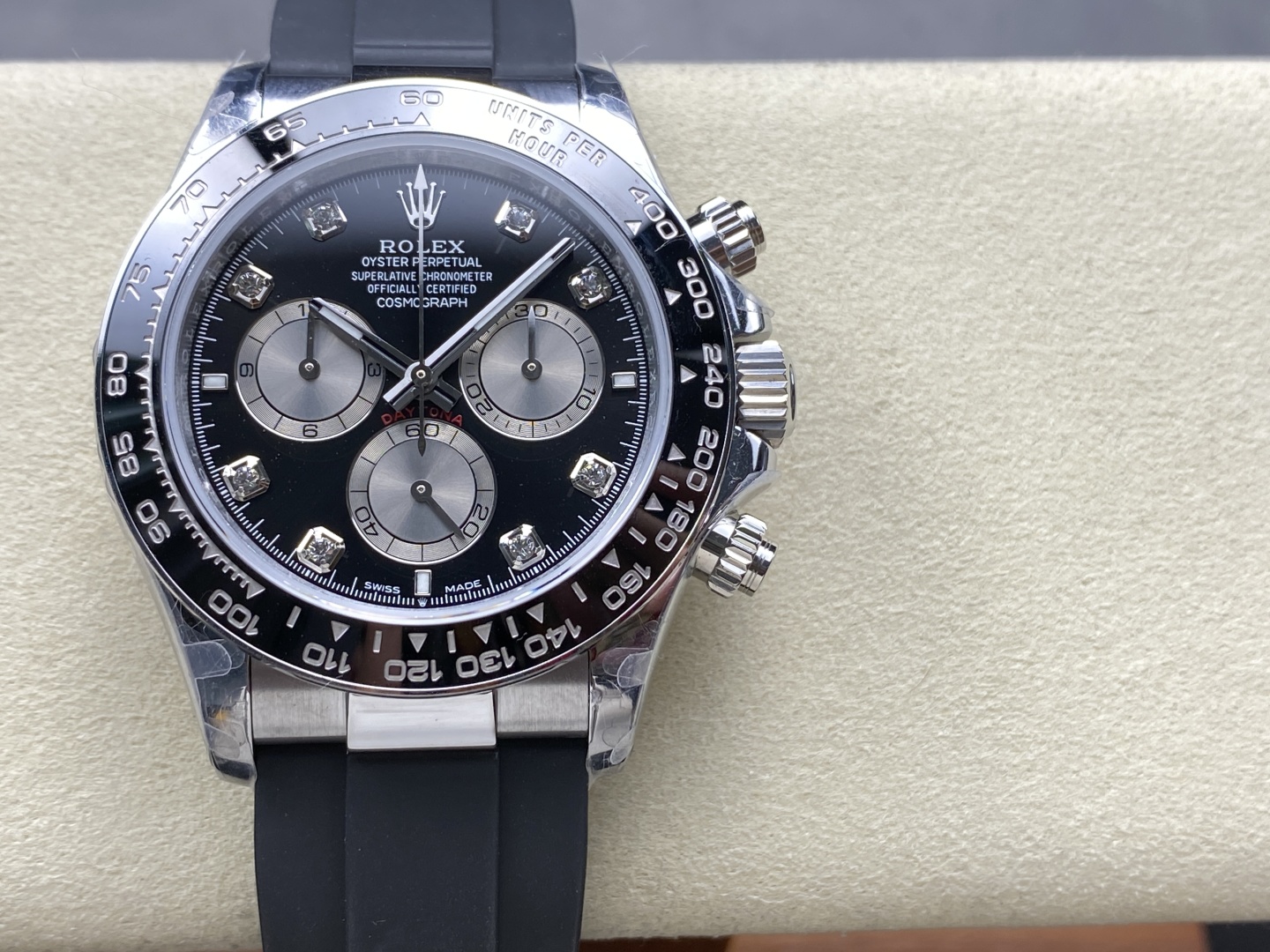
Factory reputation matters more in the replica Rolex market than in almost any other product category. The same movement can be assembled into a watch with excellent finishing or poor finishing, and the factory name is the only reliable signal of what you will receive. Clean, VS, and BT are the three names you will see most often for Daytona replicas. They are not equal. Clean is the most expensive and generally the most accurate on external details. VS offers a strong balance of movement quality and value. BT is the budget option that can still be a good watch if you manage expectations. The price difference between them is usually $200 to $400, and that money buys different things depending on the factory. Understanding those differences is the difference between a watch you love and a watch you resell at a loss.
Clean Factory: Dial Accuracy First
Clean Factory has dominated the Daytona replica market for years, and their dial work is the main reason. They reportedly buy multiple genuine watches for teardown and reverse-engineering, and that investment shows in the dial color. In the “Panda” configuration, Clean’s white dial sits in the sweet spot between cold white and warm cream that the genuine watch uses. Their case finishing, especially the lug chamfers and caseback engravings, is also the closest to genuine in the market. The bracelet is excellent, with smooth link edges and a clasp that closes with a solid click. The downside is price. A Clean Daytona with the SH4131 typically costs $700 to $850. That is a lot for a replica, but if dial accuracy is your priority, Clean is the factory to choose. For buyers who want the most convincing watch on the wrist, Clean is usually the answer.
VS Factory: Movement Finish and Value
VS Factory competes on the movement side. They use the Dandong 4131 exclusively in their Daytona line and position themselves as the movement-first option. The Dandong movement they use has visibly better bridge finishing than what Clean ships with the Shanghai movement. The VS case is nearly identical to Clean in side-by-side comparison, with differences only visible under magnification. The dial is also close, though not quite as color-accurate as Clean in the Panda version. The VS version typically costs $550 to $700, which is $100 to $300 less than the equivalent Clean model. That price difference makes VS the best value for buyers who care more about the movement and overall wearing experience than about having the single most accurate dial. In my experience, VS is the smart choice for daily wear.
BT Factory: The Budget Entry Point
BT Factory is the budget alternative. Their 4131 Daytona clones use a movement that is functionally similar but with less decorative finishing. The chronograph works, the power reserve is acceptable, and the external appearance is convincing at arm’s length. The bracelet is where the savings show most. Link edges can be slightly sharp, and the clasp does not feel as refined as Clean or VS. If you plan to wear the watch occasionally rather than daily, BT is a reasonable entry point at $400 to $500. If you plan to wear it regularly, the extra money for a Clean or VS model is worth it. The small details that separate a good replica from a great one matter more over time. A BT Daytona is not a bad watch. It is simply a watch with more visible compromises.
The Wrist Test vs Macro Test: An Original Way to Judge a Super Clone
Most reviews of replica Rolex watches focus on the macro test. They use a loupe, bright light, and side-by-side photos against genuine reference images. That approach is useful for identifying flaws, but it does not tell you what the watch is like to live with. I use a different framework: the wrist test. The wrist test is simple. You wear the watch for a week, go about your life, and see if anything bothers you. I have owned replica Rolex watches that passed the macro test beautifully and failed the wrist test badly. A Daytona clone with perfect dial printing but a bracelet that pinched my wrist hair on every movement. Another with a flawless case profile but a rotor that made a faint clicking sound whenever I raised my arm. Neither flaw would show up in a photo comparison. Both made me stop wearing the watch within a month. The wrist test is not about ignoring accuracy. It is about prioritizing the flaws you will actually experience.
Why Macro Reviews Mislead Buyers
Macro reviews are misleading because they optimize for a condition that does not exist in real life. Nobody you meet in daily life will take a loupe to your watch. They will see it from two feet away, in motion, under normal lighting. What they notice is the overall impression: the dial color, the case shape, the bracelet finish, and how the watch sits on your wrist. The macro test also creates a false hierarchy. A watch with a slightly imperfect bridge engraving can be rated lower than a watch with perfect engraving, even if the first watch keeps better time and feels better on the wrist. That hierarchy does not reflect actual ownership. From what I have seen, buyers who rely only on macro reviews often end up with watches that photograph well but disappoint in daily use. The macro test is a tool, not a final judgment.
What the Wrist Test Actually Measures
The wrist test measures comfort, weight, balance, and tactile quality. It asks whether the bracelet edges are smooth enough to wear against bare skin. It asks whether the clasp closes with a satisfying click and opens without effort. It asks whether the chronograph pushers feel gritty or smooth. It asks whether the watch keeps reasonable time without you thinking about it. It asks whether the rotor is quiet when you move your arm. These are the things you experience every time you wear the watch. A Dandong 4131 with slightly imperfect bridge finishing that runs at +4 seconds per day and feels great on the wrist is a better purchase than a movement with perfect Geneva stripes that gains 15 seconds a day and has a sticky pusher. The wrist test is not subjective. It is the only test that reflects actual ownership.
How I Apply Both Tests Before Buying
I use both tests, but in a specific order. First, I use the macro test to eliminate watches with obvious flaws: wrong dial color, wrong case shape, wrong movement version. That narrows the field. Then I use the wrist test to choose between the finalists. I ask the seller for QC photos, but I also ask about bracelet finish, clasp feel, and rotor noise. A good seller will know these details. If they do not, that is a warning sign. I also wear the watch for at least three days before deciding to keep it. If anything bothers me in those three days, it will bother me more in three months. This approach has saved me from several purchases I would have regretted. It has also helped me appreciate watches that looked average in photos but felt excellent on the wrist.
Two Common Buyer Mistakes and One Experienced Recommendation
The replica Rolex market is full of traps for new buyers. Some are obvious, like paying too much for a low-tier watch. Others are subtle, like choosing a movement that does not match the reference. I have made both mistakes myself, and I have watched other buyers make them. The two mistakes below are the ones I see most often. They are also the ones that cost the most money and cause the most disappointment. If you avoid them, you are already ahead of most first-time buyers. The recommendation at the end is the approach I would use if I were buying my first 4131 Daytona today.
Mistake One: Paying for a “Swiss” 4131 That Does Not Exist
In 2023, I bought a Daytona replica advertised as having a “Swiss ETA 4131 movement.” The price was $650, which was higher than the typical Chinese movement options. What arrived was a watch with a movement that had “Swiss Made” stamped on the rotor but was otherwise identical to a $300 Shanghai 4131 clone. There is no Swiss-made 4131 clone. ETA does not produce a 4131 clone. Any listing that claims otherwise is either misinformed or deliberately misleading. The $350 premium I paid bought me nothing except a lesson. If a seller insists their movement is Swiss-made, ask for a photo of the movement with the caseback removed. The engraving will tell the real story. A genuine Swiss ETA movement would have a different bridge layout and a different rotor design. The 4131 clone is a Chinese design, and that is fine. Just do not pay a premium for a label that does not exist.
Mistake Two: Ignoring Bracelet and Clasp Quality
My first super clone Daytona had a beautiful dial and a well-finished case, but the bracelet’s mid-link edges were sharp enough to catch on fabric. I did not notice for the first week because I was focused on the dial. By the time I did notice, I had already worn the watch enough that returning it felt impractical. Bracelet finishing is one of the most variable aspects of replica manufacturing and one of the most important for daily wear. Clean Factory’s bracelets are generally excellent. Lower-tier factories are hit-or-miss. The clasp matters too. A clasp that does not close securely or feels loose will annoy you every time you put the watch on. When you ask for QC photos, ask for close-ups of the bracelet edges and the clasp. If the seller cannot provide them, consider that a risk. The bracelet is half the wearing experience.
My Recommendation for First-Time USA Buyers
If you are buying your first 4131 Daytona replica in the USA, start with the reference. Decide whether you want the 126500LN or the 116500LN. For the 126500LN, choose a DD4131 or SH4131 movement. For the 116500LN, a 4130 clone is acceptable. Then choose the factory based on what you will notice. If dial accuracy matters most, choose Clean. If movement finish and value matter most, choose VS. If budget is the primary concern, choose BT. Buy from a seller who provides detailed QC photos and specifies the exact movement version. Replicafactory.cx is one of the few sellers I have used that consistently does both, and their listings are clear about what you are getting. You can also compare options on this page for super clone Rolex if you want to see how different sellers present the same movement. Finally, plan to spend $500 to $850 for a quality 4131 Daytona. Anything below $400 is likely a 4130 in a 126500LN case. Anything above $900 is usually unnecessary. That range is where the best value sits.
FAQ
Is the 4131 clone movement reliable for daily wear?
Yes. Based on my experience and reports from other owners, both DD4131 and SH4131 movements have shown consistent timekeeping within +/-5 seconds per day after regulation. The most common issue is the chronograph seconds hand occasionally not resetting perfectly to zero. That is usually a minor adjustment, not a mechanical failure. With regular service every three to four years, these movements hold up well.
What is the difference between DD4131 and SH4131, and does it matter?
The DD4131 has better bridge finishing and a more accurate KIF-style shock absorber. The SH4131 has darker plating and a different shock absorber design. Functionally, they perform the same. The difference matters if you plan to open the caseback and show the movement. For daily wear, it is irrelevant.
Can I get a Rolex Daytona super clone with a genuine Swiss movement?
No. There is no Swiss-made 4131 clone. Any listing claiming a “Swiss ETA 4131” is using misleading language. The 4131 is a Rolex in-house design, and the only clone versions are made in China. If a seller insists their movement is Swiss-made, ask for a photo of the movement with the caseback removed.
How much should I expect to pay for a 4131 Daytona super clone in 2025?
The realistic price range is $450 to $900. Below $400, you are likely getting a 4130 clone in a 126500LN case. Above $900, you are paying for branding or unnecessary add-ons. Clean Factory models typically sit at $700 to $850. VS Factory models sit at $550 to $700. BT Factory models sit at $400 to $500.
Will a watchmaker service a replica Rolex movement?
Some will, some will not. The safest approach is to find a watchmaker who explicitly advertises replica service work or works primarily with Asian clone movements. The DD4131 and SH4131 are based on well-documented designs, and any watchmaker familiar with the 7750 or 4130 platform can service them. Expect to pay $80 to $150 for a basic service.
Do I need to worry about water resistance with a super clone Daytona?
The Daytona is not a dive watch. Genuine models are rated to 100 meters, but the chronograph pushers are a weak point for water intrusion. For super clones, I would not trust the factory water resistance rating without testing. If you want to swim with a replica, a Submariner clone is a better choice. For the Daytona, treat it as splash-resistant at best unless you have had it pressure-tested.
How can I tell if a seller is shipping the movement they claim?
Ask for a QC photo with the caseback removed. The movement should show the correct rotor engraving, meaning 4131 and not 4130. The bridge layout should match the 4131 architecture. A seller who cannot or will not provide this photo is a seller who is not worth your money. Also look for listings that mention rolex copy watches for sale with specific movement names rather than vague terms like “clone movement.” If you want a knock off rolex that matches a modern reference, the movement version is the first thing to verify. For buyers who want rolex replicas for sale with clear movement specifications, Replicafactory.cx has been a reliable source in my experience.